Property Strategies That Add Value. For Homeowners and Real Estate Agents

Home Revitalize
Home Revitalize
  • Home
  • How It Works
    • Property System
    • What We Evaluate
    • Renovation Mistakes
    • What Buyers Notice
    • When Renovations Backfire
    • $35,000 Ceiling Fan
  • Who We Help
    • Real Estate Agent Support
    • Home Owners Start Here
  • Real Results
    • Real Property Reviews
    • ROI Guidance
    • Why Renovate for Resale
  • Our Network
    • Trade Partners
    • Become a Trade Partner
    • Real Estate Partners
    • Join our Agent Network
  • About Home Revitalize
    • About Home Revitalize
    • Community Engagement
    • FAQ
  • Start Your Strategy
  • More
    • Home
    • How It Works
      • Property System
      • What We Evaluate
      • Renovation Mistakes
      • What Buyers Notice
      • When Renovations Backfire
      • $35,000 Ceiling Fan
    • Who We Help
      • Real Estate Agent Support
      • Home Owners Start Here
    • Real Results
      • Real Property Reviews
      • ROI Guidance
      • Why Renovate for Resale
    • Our Network
      • Trade Partners
      • Become a Trade Partner
      • Real Estate Partners
      • Join our Agent Network
    • About Home Revitalize
      • About Home Revitalize
      • Community Engagement
      • FAQ
    • Start Your Strategy
  • Home
  • How It Works
    • Property System
    • What We Evaluate
    • Renovation Mistakes
    • What Buyers Notice
    • When Renovations Backfire
    • $35,000 Ceiling Fan
  • Who We Help
    • Real Estate Agent Support
    • Home Owners Start Here
  • Real Results
    • Real Property Reviews
    • ROI Guidance
    • Why Renovate for Resale
  • Our Network
    • Trade Partners
    • Become a Trade Partner
    • Real Estate Partners
    • Join our Agent Network
  • About Home Revitalize
    • About Home Revitalize
    • Community Engagement
    • FAQ
  • Start Your Strategy

The Most Expensive Renovation Mistakes Before Selling

The biggest mistake isn’t renovating. It’s renovating without a strategy. 


Before choosing paint colours, ordering flooring, or starting demolition, there’s a more important question:


Will this investment actually help the property sell?


Some improvements can strengthen buyer appeal. Some can help preserve value. Others can consume thousands of dollars without meaningfully changing the outcome of the sale.


The goal isn’t to renovate more. It’s to make better decisions before you spend a dollar.

See The Home Revitalize Property System Advantage

Overspending on Custom Finishes

The Mistake: 

Spending more than the market will reward.

It’s easy to assume that expensive materials automatically create more value. Custom cabinetry, premium countertops, designer fixtures and luxury finishes may look impressive—but buyers won’t necessarily pay more simply because you spent more.


A $20,000 upgrade doesn’t automatically add $20,000 to the value of the home


Why It Backfires

Every neighbourhood has buyer expectations and a general range of property values. When improvements significantly exceed what comparable homes offer, the seller may be paying for quality the market doesn’t require—or reward.

More expensive doesn’t always mean more profitable.

The Smarter Strategy

Match the level of investment to the property, the likely buyer, competing listings and neighbourhood values.


The goal isn’t to build the nicest house on the street. It’s to make the right improvements for the market you’re selling into.

Renovating The Wrong room

The Mistake: 

Spending money where it makes the least difference.


You can complete a beautiful renovation and still make a poor investment.


A perfectly renovated spare bedroom, laundry room or basement won’t necessarily overcome a tired entrance, dated kitchen or neglected exterior if those are the areas shaping the buyer’s overall impression.

Why It Backfires

Not every room carries equal weight with buyers.

The question isn’t simply “What could we renovate?”


It’s:

“Which improvement has the greatest potential to change how buyers perceive this property?”

Money spent in the wrong place is still money spent.

The Smarter Strategy

Prioritize the areas most likely to influence first impressions, buyer objections, move-in readiness and how the property compares with competing homes.


Start with impact—not personal preference.

Ignoring the First Impression

The Mistake: 

Focusing on the inside while buyers are judging the outside.


Buyers may form an opinion of a property before they ever walk through the front door.

They see the listing photos. They pull up to the curb. They notice the landscaping, walkway, entrance, front door and overall condition.

And that first impression can influence how they experience everything that follows

Why It Backfires

An overgrown entrance, tired front door, peeling railing or neglected landscaping can create an immediate question:


“If this is what I can see, what else hasn’t been maintained?”


Small exterior distractions can shape the buyer’s expectations before the showing has even begun.

The Smarter Strategy

Focus on creating a clean, cared-for and welcoming first impression—not necessarily an expensive one.


You don’t always need to transform the exterior. Sometimes you simply need to remove the reasons buyers hesitate.

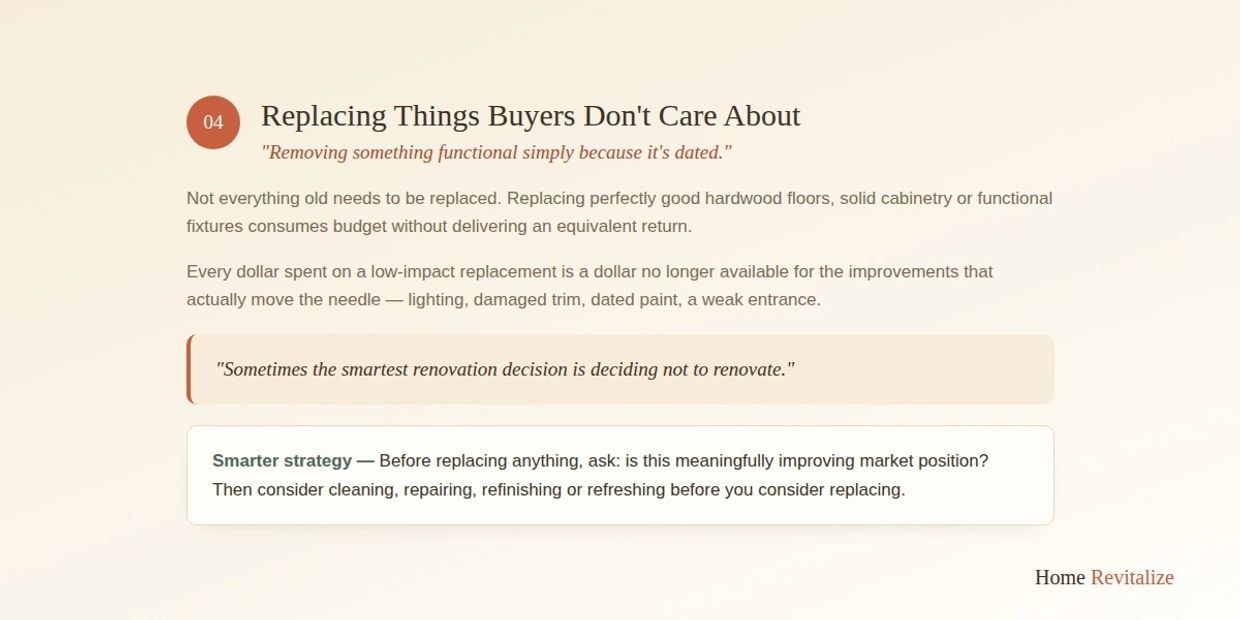
Replacing Things Buyers Don’t Care About

The Mistake: 

Removing something functional simply because it’s dated.


Not everything old needs to be replaced.


Perfectly good hardwood floors, solid cabinetry, functional bathroom fixtures or older finishes may still have plenty of life—and replacing them can consume a large part of the renovation budget without creating enough additional impact.

Why It Backfires

 Every dollar spent on a low-impact replacement is a dollar that can’t be used somewhere more important.


A seller might spend thousands replacing functional flooring while ignoring poor lighting, damaged trim, dated paint or a weak entrance that buyers notice immediately.


The question isn’t whether something is old. It’s whether replacing it meaningfully improves the property’s market position..

The Smarter Strategy

Before replacing anything, ask:

Can it be cleaned, repaired, refinished, refreshed—or simply left alone?


Sometimes the smartest renovation decision is deciding not to renovate.

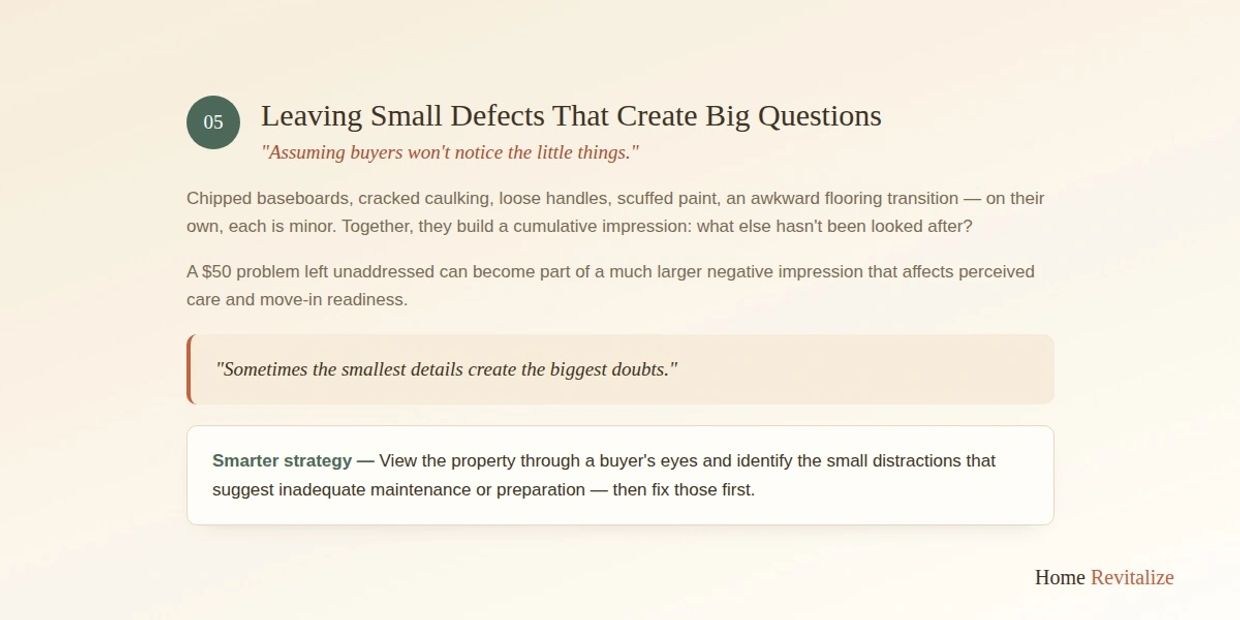
Leaving Small Defects That Create Big Questions

The Mistake: 

Assuming buyers won’t notice the little things.


A chipped baseboard. Cracked caulking. A loose handle. Scuffed paint. An awkward flooring transition.

Individually, none of these may seem significant.

But buyers don’t always experience them individually.

Why It Backfires

When small defects begin accumulating throughout a property, they can create a much bigger perception:


“What else hasn’t been looked after?”


That’s where a $50 problem can become part of a much more expensive impression.

The issue isn’t always the cost of the repair itself. It’s what the visible defect causes the buyer to question about the rest of the home.

The Smarter Strategy

Look at the property through the buyer’s eyes.


Identify the small distractions that make a home feel less cared for, less move-in ready or less deserving of its asking price.


Sometimes the smallest details create the biggest doubts.

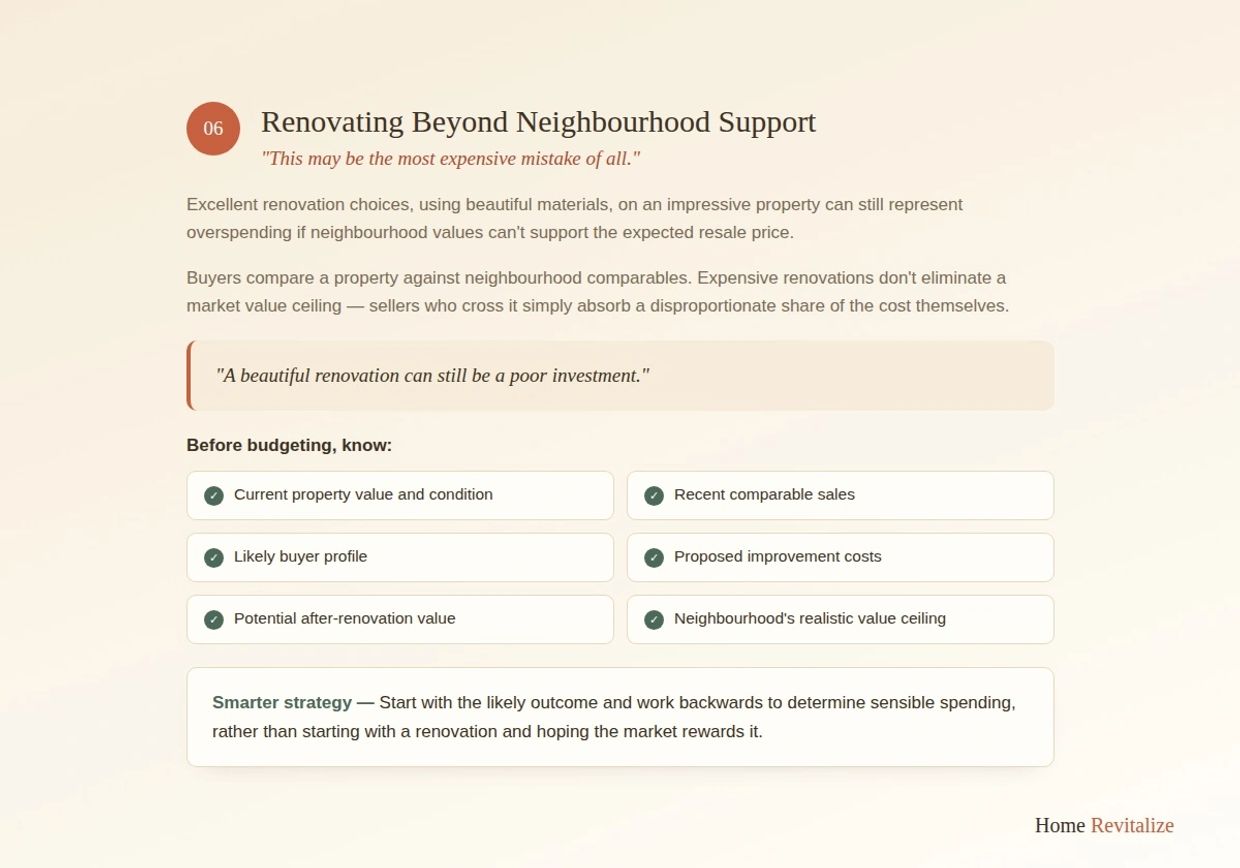
Renovating Beyond What the Neighbourhood Can Support

The Mistake: 


This may be the most expensive mistake of all.


A homeowner can make excellent renovation choices, use beautiful materials and create an impressive property—and still overspend if the neighbourhood can’t support the expected resale value.

Why It Backfires


Buyers compare properties against other homes in the same market.

If comparable sales establish a general value range, expensive renovations don’t automatically eliminate that ceiling. The seller may create the best house on the street while absorbing much of the cost themselves.


A beautiful renovation can still be a poor investment.

The Smarter Strategy


Before establishing a renovation budget, consider:

✅The property’s current value and condition

✅Recent comparable sales

✅The likely buyer profile

✅The cost of proposed improvements

✅The potential after-renovation value

✅The neighbourhood’s realistic value ceiling


Start with the potential outcome. Then work backwards to determine how much it makes sense to spend.

Avoiding These Mistakes Starts With the Right Strategy

 The Home Revitalize Property System doesn’t begin by asking:


“What can we renovate?”

 We begin by asking:


“What does this property actually need—and what should be left alone?”

We look at the home’s condition, buyer appeal, move-in readiness, visible distractions, comparable properties, renovation costs and potential return to help determine where your money may have the greatest impact.

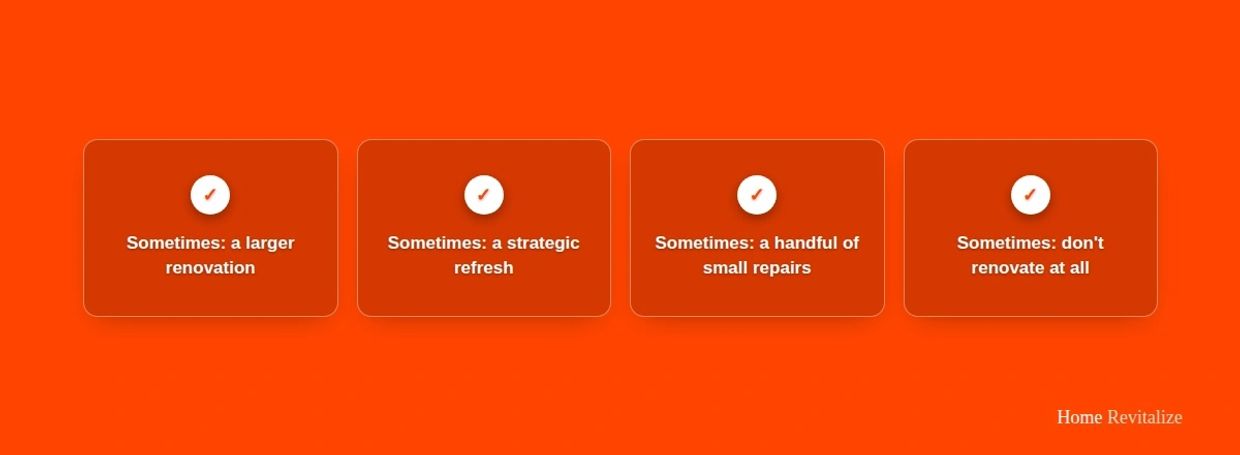
✅Sometimes the answer is a larger renovation.

✅Sometimes it’s a strategic refresh.

✅Sometimes it’s a handful of small repairs.


✅And sometimes, the smartest recommendation is:


Don’t renovate it.

Before you spend a dollar renovating, spend 60 minutes with us.

For a limited time, our $495 Property Strategy Report is currently being offered free of charge  — We will assess your property, identify potential opportunities and risks, and provide a personalized strategy for preparing your home for sale . 


Receive Your Complimentary Property Strategy

Copyright © 2026 Home Revitalize - Property System  - St Thomas - London - All  Rights Reserved 

Powered by

  • Home
  • Property System
  • Real Estate Agent Support
  • Real Property Reviews
  • About Home Revitalize
  • Start Your Strategy
  • Privacy Policy
  • Terms and Conditions

This website uses cookies.

We use cookies to analyze website traffic and optimize your website experience. By accepting our use of cookies, your data will be aggregated with all other user data.

Accept